
Updated: June 18, 2026
Your website is your highest-volume sales rep. For a SaaS company, it works around the clock, shapes every conversation your sales team walks into, and increasingly determines whether AI search engines like ChatGPT and Perplexity recommend you to buyers who never visit your site at all. The right SaaS web design agency can compound those advantages for years. The wrong one can set your growth back by quarters.
This guide is for SaaS founders, marketing leaders, and ops leaders who are trying to make a real call on which SaaS web design agency to hire. We’ll cover what makes SaaS web design different from web design generally, what to look for in a SaaS design agency, how to evaluate firms credibly, and which 12 agencies are operating at the top of the category in 2026.
JUMP TO:
Understanding SaaS web design (and why it’s different)
SaaS web design isn’t just web design with a software product attached. The discipline has its own logic, shaped by how SaaS companies actually sell, grow, and retain customers. Before you evaluate agencies, it helps to understand what makes the work different.
What sets SaaS web design apart?
SaaS websites need to explain abstract software products to skeptical buyers, support self-serve trials and demos, build credibility with technical evaluators, and integrate with product analytics. Increasingly, they also need to get cited by AI engines that answer buyer questions. A few other realities also shape why SaaS web design is its own discipline:
- SaaS buyers are sophisticated and skeptical. A B2B SaaS buyer typically compares three to seven vendors before booking a demo. Your website has to differentiate fast—on positioning, design polish, and substantive proof—or you’re cut from the consideration set before your sales team is ever involved.
- The website is part of the product experience. Free trial signups, gated features, self-serve demos, in-product upgrade flows are critical SaaS touchpoints all live partially on the marketing site and have to feel coherent with the product itself.
- Buying committees, not individual buyers. A SaaS purchase usually involves five to seven stakeholders with different wants and needs. A CFO wants ROI; a security lead wants compliance proof; a practitioner wants integration details. The website has to speak to all of them.
- AI search is reshaping discovery. AI search is reshaping discovery. ChatGPT, Perplexity, Claude, and Google’s AI Overviews increasingly answer buyer questions about vendors before the buyer ever reaches sales or even a traditional search results page. SaaS websites have to be optimized, not just to rank in Google, but to be cited in AI-generated answers. That’s a discipline most generalist web design firms haven’t yet addressed
Key elements of effective SaaS websites
The strongest SaaS marketing websites share a few structural characteristics. When you’re evaluating an agency’s past work, these are the elements worth looking for in their portfolio:
- A clear, extractable answer to “what does this product do?” AI engines reward direct, definitional content, and human buyers won’t engage if they can’t quickly figure out what a product does (and what’s in it for them).
- Proof distributed throughout the site, not just on a case studies page. Logos, quantified outcomes, named clients, and integration partners appear in context next to the claims they support.
- Self-serve demo paths and free-trial flows that don’t require a sales conversation, paired with clear paths for buyers who do want one.
- Comparison and “vs.” pages that own the keyword real estate for buyer-intent searches like “Plaid alternatives” or “Stripe vs. Adyen.”
- Technical depth where the audience demands it. API docs, security pages, integration libraries, and status pages should presented in a way that signals product maturity rather than overwhelming non-technical visitors.
- A design system that the in-house team can extend without breaking the brand. The agency that built your site shouldn’t be the only team capable of updating it.
Why choose a specialized SaaS web design agency?
Many generalist web design agencies produce beautiful work. But SaaS is a category where the wrong strategic choice compounds. A year of weak content and conversion architecture is a year of lost pipeline, and generalist agencies don’t have to knowledge or experience to guide website strategy for a niche like SaaS.
Benefits of engaging a SaaS branding agency for website design
A SaaS branding agency brings three things to website design projects that a generalist firm usually can’t:
- Fluency in B2B SaaS positioning. They understand a SaaS company’s place in the competitive landscape, the strategic perception the company is trying to cultivate, and how both should influence countless website design decisions.
- Design vocabulary tuned to the category. They know the visual cues, motion patterns, and information density that signal “modern software” to a skeptical buyer.
- An understanding of how brand and content reinforce each other across long sales cycles and multi-stakeholder buying committees, where a fragmented brand experience can quietly kill a deal.
In turn, beyond producing a website, a good SaaS website design firm functions as a strategic partner across three dimensions:
- Brand positioning. They help you articulate what makes your product different through strategic wireframing in a way that resonates across the buying committee.
- Conversion architecture. They structure the site so that high-intent visitors find paths to demo or trial without friction, while lower-intent visitors get the educational content they need to come back ready to buy.
- Long-term scalability. They build a design system, content infrastructure, and analytics setup that your in-house team can extend without recreating the wheel each quarter.
The firms that operate at this level don’t treat web design as a one-time project. They build for the post-launch phase, which determines whether the site actually contributes to revenue over time.
What are the characteristics of an effective SaaS design agency?
Across hundreds of agencies in this category, the strongest contenders consistently demonstrate the same five capabilities. These are also the criteria we used to evaluate every agency on the list below—and they’re the criteria we’d recommend any SaaS buyer use when shortlisting on their own.
Expertise in user experience (UX) and user interface (UI)
SaaS web design lives at the intersection of brand, marketing, and product, so UX and UI fluency isn’t optional. The strongest agencies on this list employ senior product designers who understand information architecture, user journeys, interaction patterns, accessibility standards, and the specific UX challenges of SaaS marketing sites, like how to present pricing, how to handle multi-persona navigation, how to structure long-form product pages, and how to design self-serve flows that don’t feel like sales funnels.
When you’re evaluating an agency, the fastest signal here is to ask who, specifically, will be working on your account. Senior product designers and creative directors should be in the room from kickoff through launch—not just during the pitch.
A proven track record of success
Track record matters in two distinct ways:
- The first is portfolio depth: Does the agency have demonstrated experience in B2B SaaS, ideally in your vertical?
- The second is measurable results: Do their case studies cite quantified outcomes like demo signup increases, organic traffic growth, or pipeline contribution, or do they stop at aesthetic deliverables?
The strongest SaaS website design company contenders publish detailed case studies with named clients and specific outcomes.
Comprehensive SaaS design services offered
The agencies that operate at the top of this category typically offer integrated SaaS design services across strategy, brand identity, UX/UI, web design, development, and, increasingly, AEO and GEO. That doesn’t mean every project needs all of them, but it does mean the agency can see the full picture, including how the brand connects to the website, how the website connects to the product, and how the product connects back to the brand as the company scales.
Agencies that only do execution, with no strategic capability, tend to produce work that looks good but doesn’t move pipeline. The strongest firms do both, with the same senior team responsible for the whole arc.
Our methodology, briefly. We evaluated every agency on this list against the five criteria above, weighted equally. We reviewed each agency’s own website and published work, their public case study library, third-party reviews on Clutch and G2 where available, and a sample of work read end to end. We did not interview agencies or accept submissions for inclusion. Two criteria we recommend buyers also evaluate—process and cultural fit—can only be partially assessed from outside a client relationship, so we used third-party reviews as a proxy where coverage was substantial. This is why we recommend running a paid pilot before signing a long-term retainer. The full methodology and disclosure are documented in the agency list section below.
Case studies: successful SaaS website design projects
Examining real engagements is one of the most effective ways to evaluate a SaaS design agency. Below are two case studies from Block Club’s portfolio that demonstrate what brand-led web design looks like when applied to B2B SaaS and fintech infrastructure companies.
Airship: closing the brand gap for a category pioneer
Airship has been shaping mobile customer experiences since 2009, pioneering the first push notification, the first mobile wallet boarding pass, and—more recently—the industry’s first collaborative AI agents for customer engagement. Brands like Nike, Starbucks, the BBC, Allstate, and PayPal rely on the platform every day. But by 2026, the market still largely knew Airship as a push notification company, even though the platform had evolved into a full cross-channel customer experience suite.
Block Club worked with Airship’s CMO to lead the executive team through a comprehensive rebrand: brand awareness research and competitive positioning, a brand messaging platform connecting the company’s pioneering legacy to its current capabilities, a visual identity refresh with a flexible templates package for the in-house team, a full redesign of airship.com engineered for conversion across a multi-stakeholder buying committee (built end-to-end by Block Club on WordPress and Pantheon), and a wraparound launch campaign spanning digital and out-of-home.
Codat: repositioning a fintech to define a new category
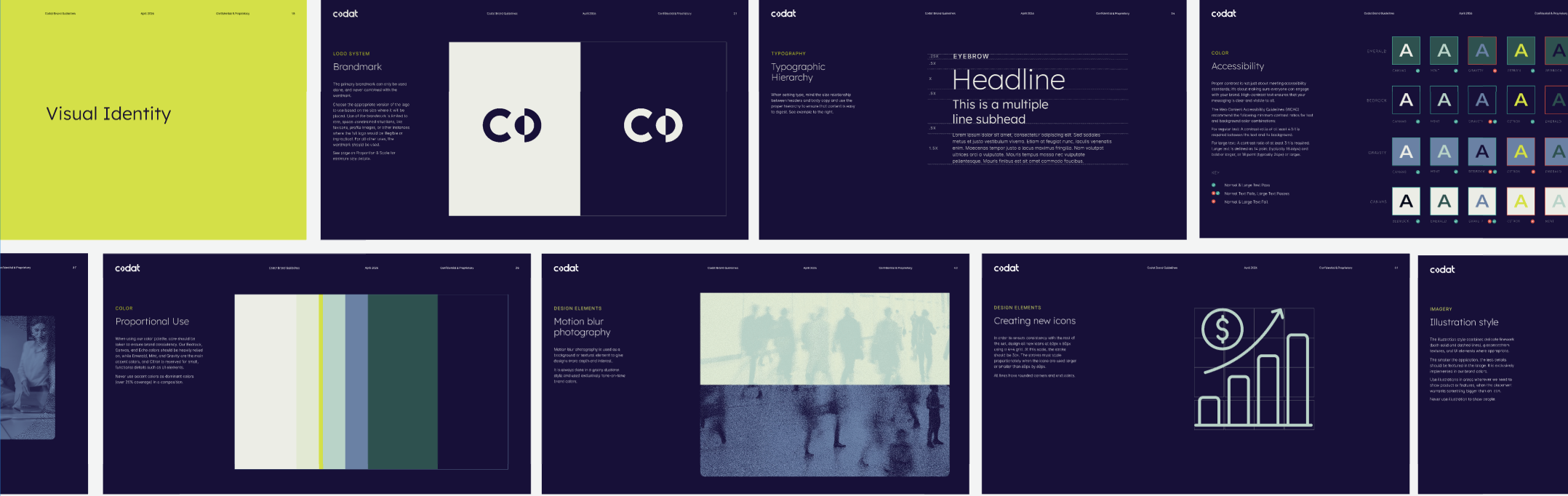
Codat is a B2B fintech backed by J.P. Morgan, PayPal, Amex, Plaid, and Shopify. With the launch of a new flagship product, Spend Insights, Codat’s primary buyer had shifted from developers at fellow fintechs to relationship managers and senior leaders at top-tier banks. At the same time, the company’s “universal API for small business data” positioning had been commoditized by competitors.
Block Club built a new brand strategy that staked out an entirely new market category—”advisory intelligence for commercial banking”—along with a full messaging platform, visual identity refresh, and a Figma-led website redesign coordinated with a development partner. The result: a category-defining brand that lets Codat sell to top-tier banks without alienating the loyal fintech audience that built the business.
Choosing the right SaaS website design company
Even with the right list of candidates, the actual selection process can take months. A few practical steps can compress that timeline without compromising the decision.
7 essential questions to ask potential agencies
Beyond reviewing case studies and portfolios, the strongest signal comes from how an agency handles discovery conversations. A few questions worth asking every agency before working with them:
- How do you approach discovery for a SaaS company we don’t already know? Walk us through the first phase of work.
- Which senior team members will be on our project, and what percentage of their time will we get? (Watch for bait-and-switch: senior people pitching, junior people executing.)
- Can you walk us through a project where the work didn’t go well, and what you learned from it? (Honest answers are a strong signal; deflection is a red flag.)
- How do you measure success on a SaaS web design project beyond launch? What does post-launch support look like?
- How are you handling AEO/GEO in current projects? (This separates current thinking from outdated playbooks.)
- Which competitors have you worked with, and how do you handle conflicts of interest in our category?
- What’s your typical project timeline from kickoff to launch, and what causes timelines to slip when they slip?
Budget considerations and pricing models
SaaS web design pricing varies significantly by agency, scope, and engagement model. A few general anchors worth knowing as you build your shortlist:
- Subscription-based design teams (typically structured as a fixed monthly fee for a dedicated designer) range from roughly $3,000 to $8,000 per month and work best for ongoing iteration and product UX rather than one-time website projects.
- Boutique B2B SaaS web design engagements typically run $25,000 to $100,000 for a complete website project. This is where most of the agencies on the list below operate, and it’s where the best ROI lives for Series A through growth-stage SaaS companies.
- Enterprise-tier brand and web engagements with the most senior global firms can run $100,000 to $500,000 or more, particularly when brand strategy, content, and development are bundled into a single integrated engagement.
Beyond headline pricing, watch for what’s included: copywriting, custom illustration, development, SEO setup, AEO/GEO optimization, ongoing support, and analytics implementation all add up. The strongest agencies are transparent about what is and isn’t in scope before you sign.
Leading SaaS web design agencies in 2026
Below are 12 of the strongest SaaS web design agencies operating today.
Methodology: We evaluated every agency on this list against the five criteria above, weighted equally. We reviewed each agency’s own website and published work, their public case study library, and third-party reviews on Clutch and G2 where available. We did not interview agencies or accept submissions for inclusion. Two criteria we recommend buyers also evaluate—process and cultural fit—can only be partially assessed from outside a client relationship, so we used third-party reviews as a proxy where coverage was substantial.
Disclosure: Block Club is the publisher of this article and is included on the list. To mitigate the obvious conflict, we applied the same evaluation criteria to ourselves that we applied to every other agency, and we included direct competitors who regularly compete with Block Club for the same deals.
Use the table for a quick summary of the 12 SaaS web design agencies. It distills each agency’s best-fit use case, core service mix, and standout proof points so you can scan the full field before diving into individual agency writeups.
| Agency | Best for | Core services | Standout proof | Key tradeoff |
|---|---|---|---|---|
| Block Club | B2B SaaS / fintech; brand + web as one engagement | Brand identity, messaging, web design, AEO/GEO, content | Plaid content engine: $25M in closed opps; Airship full rebrand + website; Codat new category definition | Brand-led; website-only projects better served elsewhere |
| Baunfire | Enterprise B2B tech; Bay Area companies wanting senior attention | Web + UI/UX design, front-end dev, brand + digital strategy | Google, Sapphire Ventures, Benchling; 20+ years in Silicon Valley B2B | ~10-person team limits capacity for parallel workstreams |
| Bop Design | B2B SaaS focused on top-of-funnel conversion and content-driven growth | B2B web design, content marketing, branding, SEO, copywriting | Woman-owned; 100% B2B focus since 2008; integrated website + content marketing model | Not suited for in-app / product UX work |
| Clay | Growth-stage and enterprise SaaS wanting premium brand + UI/UX | Brand strategy, visual identity, web design, UI/UX, design systems, mobile | Slack, Stripe, Coinbase, Snapchat, Google; co-founders on every project | Premium pricing puts them out of reach for most early-stage startups |
| Eleken | Early- to growth-stage SaaS needing a dedicated product designer on subscription | SaaS product UI/UX, design systems, MVP design (design only — no dev) | 200+ SaaS products designed; 4.9 on Clutch (122+ reviews); $3K–$8K/mo model | Design only — requires in-house engineering to ship |
| Focus Lab | Venture-backed B2B SaaS investing in comprehensive brand + Webflow site | Brand strategy, visual identity, brand messaging, web design, Webflow dev | Marketo (Adobe), Braze, Mailchimp, GitHub, Outreach; 15+ years B2B-only | No in-house dev for complex builds beyond Webflow |
| Halo Lab | SaaS startups wanting high-quality design at below-US-market pricing | UI/UX, web design, branding, web dev, SaaS product design | 4.9 on Clutch (90+ reviews); Grammarly, GitLab (reported) | Andorra registration adds legal complexity for US enterprise vendor onboarding |
| Huemor | SaaS companies treating the marketing site as a primary conversion asset | Web design, SaaS websites, branding, CMS, custom dev | 350+ projects; 4.9 Clutch (72+ reviews); transparent published pricing | Marketing-site focused; not a fit for in-app product design |
| Orbit Media | B2B SaaS wanting web design tightly integrated with SEO, content, and CRO | Web design + dev, SEO, CRO, content marketing, analytics | B Corp certified; 25 years in market; AI discoverability audits built into projects | SEO-led focus; less suited for bold, brand-first visual identity work |
| Ramotion | Venture-backed SaaS wanting integrated brand + UI/UX from a SF-based agency | UX/UI, brand identity, web design, design systems, mobile app design | Salesforce, Netflix, Okta, Mozilla; Volusion: $29B global merchant sales; Transcend: 1.2B+ users | Brand-led; not the strongest fit for deep UX research or extensive user testing |
| Refokus | High-growth Series A–B SaaS needing fast, animated Webflow sites | Webflow design + dev, motion design, brand strategy, WebGL/GSAP/AI integrations | $1M+ Webflow revenue in year one; 200+ sites; Awwwards, FWA, CSSDA recognition | Webflow-native — limited for complex technical requirements or non-Webflow stacks |
| Tubik | SaaS scaling from MVP to growth stage needing high-volume design execution | UI/UX, web design, mobile app design, branding, motion, illustration | 400+ portfolio projects; Setapp (240 Mac apps); Webby, Red Dot, Awwwards; 150K+ Dribbble following | Execution-strong; less suited for B2B strategic positioning as part of the engagement |
Block Club
Best for: Fast-growing B2B SaaS companies, particularly in fintech infrastructure, martech, and enterprise AI, that want SaaS branding work and website design treated as one integrated engagement.
Notable clients: Plaid, Alloy, Airship, Lithic, Pigment, Argyle, Middesk, Zero Hash, Symmetry, Prose, Codat, Culture Amp, Tubi
Services: Brand identity, brand messaging, content systems, AEO/GEO, messaging platforms, web design, research and insights
Block Club is a B2B branding and content agency for fast-growing SaaS companies, with a particular specialization in fintech, martech, and enterprise AI. We treat brand identity, content, and web design as one integrated discipline—because they’re all expressions of the same underlying positioning.
Public engagements include the Airship rebrand and website redesign, the Codat repositioning and website redesign that defined a new market category, and the Singular brand identity and website for Prose’s B2B beauty tech platform, plus a multi-year Plaid content engagement that contributed to $25M in closed opportunities through customer story and sales enablement content.
Honest tradeoff: Block Club is a brand-led agency, not a pure web design specialist. We do web design as part of brand engagements—usually one to three sites per year—rather than as a standalone, high-velocity service. Companies that want a website-only project with no brand component, or that need rapid Webflow turnaround on landing pages, are usually better served elsewhere.
Baunfire
Best for: Enterprise B2B tech and SaaS companies in Silicon Valley wanting a Bay Area-based partner with two decades of digital experience.
Notable clients: Google, Nike, Sapphire Ventures, Norwest Venture Partners, Netgear, Benchling, Arlo
Services: Web and UI/UX design, front-end web development, brand and digital strategy, B2B marketing websites
Baunfire is a Silicon Valley-based digital agency founded in 2001 that specializes in B2B enterprise clients and funded startups. The team is small and senior—about 10 people—and works primarily with leading global brands, venture capital firms, and growth-stage tech companies in the Bay Area. Their service mix combines UX, creative design, and development under one roof, with a particular focus on B2B marketing websites and SaaS-specific projects.
Honest tradeoff: Baunfire’s small team size is a strength for senior attention, but may be a limitation for companies needing rapid scaling or parallel workstreams across many sites.
Bop Design
Best for: B2B SaaS companies focused on top-of-funnel marketing website performance, demo requests, and content-driven conversion.
Notable clients: Range of B2B SaaS, fintech, and professional services firms (specific clients require NDA disclosure)
Services: B2B web design, content marketing, branding, SEO, copywriting
Bop Design is a woman-owned B2B agency founded in 2008 by Jeremy Durant and Kara Jensen, with a 100% focus on B2B branding, web design, and content marketing. The agency built its reputation around the recognition that B2B client acquisition is fundamentally different from B2C, and structures its service offering accordingly: brand positioning and messaging first, then a website built to support a full B2B sales funnel, then ongoing content marketing to feed it. Their typical SaaS website project runs 16 to 20 weeks from discovery to launch.
Honest tradeoff: Bop Design’s strength is the integrated B2B website-plus-content-marketing engagement. Companies needing pure UI/UX design for product surfaces (in-app dashboards, complex data interfaces) are better served by product-focused agencies.
Clay
Best for: Growth-stage and enterprise B2B SaaS companies that want premium UI/UX, brand, and web design from a globally recognized firm.
Notable clients: Slack, Google, Stripe, Coinbase, Facebook, Amazon, Snapchat, Credit Karma, ADP, UPS, Sony, Marqeta
Services: Brand strategy and visual identity, web design, UI/UX, web development, design systems, mobile app design
Clay is a UI/UX design and branding firm headquartered in San Francisco, with over a decade of experience designing for B2B, SaaS, AI, and fintech clients. Their portfolio includes some of the most recognizable products in tech—Slack, Stripe, Coinbase, Snapchat—and their design work is known for polished animations, product-led visuals, and the ability to communicate complex software in a way that signals enterprise-grade quality. Clay’s co-founders lead dedicated senior-level teams on each project, which the agency frames as a deliberate alternative to large agencies where junior talent does most of the work.
Honest tradeoff: Clay’s premium positioning and pricing put them out of reach for most early-stage startups
Eleken
Best for: Early-stage and growth-stage SaaS startups that need a dedicated product designer on a flexible subscription model.
Notable clients: Gamaya, TenderX, TextMagic, plus 200+ SaaS products across AI, geoservices, devtools, and no-code platforms
Services: SaaS product UI/UX design, design systems, MVP design, team extension (design only—no development)
Eleken is a distributed UI/UX design agency founded in 2015 that specializes exclusively in SaaS products. The agency operates on a subscription-based model with a fixed monthly fee, providing vetted designers trained through a three-month UX bootcamp and supported by senior design oversight. Over a decade, Eleken has designed or redesigned 200+ SaaS products, from early-stage MVPs to complex, data-heavy enterprise platforms, with a particular depth in AI, healthtech, fintech, and developer tools. The agency holds a 4.9 rating on Clutch across 122+ reviews.
Honest tradeoff: Eleken provides design-only services—they don’t offer development. Their model works best for teams that already have engineering resources and need ongoing product design capacity rather than one-time marketing website builds.
Focus Lab
Best for: Venture-backed and growth-stage B2B SaaS companies investing in a comprehensive brand identity with web design as a core component.
Notable clients: Marketo (Adobe), Storybots (Netflix), Outreach, Braze, Udacity, Frame.io, Deputy, Salesloft, Crossbeam, ASAPP, Mailchimp, GitHub
Services: Brand strategy, visual identity, brand messaging, web design, Webflow development
Focus Lab is a global B2B brand agency founded in 2010 in Savannah, Georgia. The agency works almost exclusively with B2B technology companies, with particular depth across SaaS, martech, fintech, and education. Their practice combines brand strategy, visual identity, brand messaging, and Webflow-based web design, with a structured weekly cadence designed for teams that want to move fast through brand initiatives. Focus Lab has built a reputation across more than a decade as one of the most respected B2B brand-and-website firms, with a roster that includes some of the most recognizable names in B2B tech.
Honest tradeoff: Focus Lab does not offer in-house web development services—they design websites in Webflow but recommend development partners for more complex builds. Companies needing a single-vendor design-and-development engagement will want to consider the potential for handoff friction.
Halo Lab
Best for: SaaS startups and growth-stage companies seeking high-quality design at competitive pricing relative to US-based agencies.
Notable clients: Reportedly includes work for Grammarly, GitLab, and a range of SaaS startups
Services: UI/UX design, web design, branding, web development, SaaS product design
Halo Lab is a distributed design agency founded around 2014, with a portfolio focused on startups, SaaS companies, and digital services. The agency combines Eastern European design talent with competitive pricing that significantly undercuts comparable US-based firms, and operates with a 4.9 rating across 90+ Clutch reviews. Their service mix spans UI/UX design, web design, branding, and custom web development, with a particular focus on SaaS landing pages and startup web design.
Honest tradeoff: Halo Lab is registered in Andorra rather than the US, which can add legal complexity for US-based clients with strict vendor onboarding requirements. The price advantage is real, but buyers should factor in the legal and contractual implications before signing.
Huemor
Best for: SaaS companies that treat their marketing website as a primary conversion asset and want a US-based partner with deep conversion design experience.
Notable clients: Range of B2B SaaS, work management, and enterprise software clients (350+ projects completed)
Services: Web design, SaaS website design, branding, content management systems, custom development
Huemor is a New York-based website design agency founded in 2011 that builds high-conversion SaaS websites, marketing pages, and digital product interfaces. The agency holds a 4.9 Clutch rating across 72+ reviews and has completed more than 350 web design projects. Huemor’s methodology combines visual design with conversion rate optimization and a/b testing, making it a strong fit for SaaS products entering competitive markets where the marketing website has to do meaningful sales work. The agency is known for transparent pricing—they publish ranges openly on their site, which is unusual in the category.
Honest tradeoff: Huemor’s focus is the marketing website as a conversion asset; companies looking for ongoing in-app product design support or design systems for complex SaaS product dashboards are typically better served by product-focused firms.
Orbit Media
Best for: B2B SaaS and technology companies that want website design tightly integrated with SEO, content strategy, and CRO from a long-established B Corp.
Notable clients: Storable, plus a range of B2B SaaS, technology, professional services, and manufacturing clients
Services: Web design and development, SEO, conversion rate optimization, content marketing, analytics
Orbit Media is a Chicago-based digital agency founded in 2001, with B Corp certification and a focus on B2B websites built to perform as lead generation assets. The agency specializes in SaaS and technology marketing sites with built-in conversion optimization, AI discoverability audits, and SEO infrastructure designed to compound traffic over time. With nearly 25 years in the market, Orbit Media has one of the deepest track records on this list, particularly for B2B companies that view content marketing and web design as a single integrated discipline.
Honest tradeoff: Orbit Media’s strengths are SEO-led B2B websites and digital marketing. Companies wanting bold, design-forward visual identity work or premium brand-first engagements may find the focus less of a fit.
Ramotion
Best for: Venture-backed SaaS startups and enterprise tech companies wanting integrated brand and UI/UX from a San Francisco-based agency.
Notable clients: Salesforce, Netflix, Okta, Mozilla, Xero, Adobe, Citrix, Volusion, Turo, MetaSpark
Services: UX/UI design, brand identity, web design, design systems, mobile app design
Ramotion is a San Francisco-based agency with a distributed global team of approximately 40 people. The agency blends brand identity and UX design for startups and tech companies, with particular depth in design systems and SaaS marketing sites. Public case studies cite outcomes including a Volusion engagement that contributed to $29B in global merchant sales and a Transcend website redesign that supported growth to 1.2B+ users. Ramotion is widely cited as one of the strongest “brand-plus-product” agencies in the SaaS space, especially for clients that want both disciplines from the same team.
Honest tradeoff: Ramotion is brand-led rather than deeply technical; companies needing deep UX research or extensive user testing may want to look elsewhere.
Refokus
Best for: High-growth SaaS startups and Series A-B companies that need fast, animated Webflow sites with strong visual differentiation.
Notable clients: Brightwave, Josys, Botify, Framer, plus AI-first SaaS startups
Services: Webflow design and development, motion design, brand strategy, creative development (WebGL, GSAP, AI integrations)
Refokus is a creative Webflow agency founded in 2021 with a distributed team and Webflow Enterprise Partner status. The agency specializes in rapid Webflow builds with advanced animations, motion design, and creative development capabilities that push beyond what most Webflow agencies deliver. Refokus generated $1M+ in revenue from Webflow projects in their first year and has launched 200+ sites, with a portfolio that focuses on design-forward SaaS brands where visual differentiation is part of the competitive strategy. The agency is recognized by Awwwards, FWA, and CSSDA.
Honest tradeoff: Refokus is Webflow-native, which is a strength for speed and animation but a limitation for companies whose technical requirements push beyond what Webflow supports. The animation-heavy aesthetic also works best for brands where bold visual differentiation supports the positioning, not all SaaS categories.
Tubik
Best for: SaaS companies scaling from MVP to growth stage that need a high-volume design partner with a deep documented portfolio.
Notable clients: Setapp (subscription platform for 240 Mac apps), plus 400+ published portfolio projects across SaaS, mobile apps, and digital brands
Services: UI/UX design, web design, mobile app design, branding, motion design, illustration
Tubik is a Ukraine-based design agency founded in 2013 that has built one of the most widely recognized portfolios in the global SaaS and product design community, with over 400 published projects and a following exceeding 150,000 on Dribbble. The agency has earned recognition from the Webby Awards, Red Dot, and Awwwards, and has worked across SaaS websites, mobile apps, design systems, and digital brand identities. Notable work includes the Setapp subscription platform interface and design system, which scaled across 240 Mac applications.
Honest tradeoff: Tubik’s strength is design execution and visual quality at scale. Companies needing deep B2B SaaS strategic positioning and brand work as part of the same engagement may find the orientation more execution-focused than strategy-led.
Elevate your brand with the right SaaS partner
Choosing a SaaS web design agency is one of the higher-stakes decisions a SaaS marketing or founding team will make. A strong partnership can compound for years—shaping how buyers perceive your brand, how AI engines describe you, and how your in-house team builds on the foundation in the years after launch. The wrong choice can leave you with a beautiful site that doesn’t move pipeline, or a fast launch that needs to be rebuilt within 18 months.
The 12 agencies on this list each represent the strongest in market for a particular use case. If Block Club is one of the agencies you’re considering, we’d love to be part of your evaluation. We work with fast-growing B2B SaaS companies—particularly in fintech infrastructure—to build brand identities, content engines, and websites that demonstrate real subject matter expertise and drive pipeline. Reach out to our team to discuss whether Block Club is the right fit for your project, or explore our case studies to see what that work has looked like for companies like Plaid, Airship, Codat, and Prose.