

Updated: June 2, 2026
Content marketing has evolved from a nice-to-have to an essential growth driver for B2B companies building the next generation of technology. Still, many struggle to create B2B content strategies that effectively build their brand and generate and nurture qualified leads.
This guide demystifies the world of B2B content marketing for tech businesses, from basic concepts and strategies to more advanced tactics that drive measurable pipeline growth. Throughout, we break down the foundational elements of B2B content marketing while linking to more detailed resources to help you build a content engine that consistently attracts, educates, engages, and converts your ideal buyers.
JUMP TO:
What is B2B content marketing?
At the most basic level, B2B content marketing is the strategic creation and distribution of valuable content designed to attract, engage, and convert business buyers.
Unlike B2C marketing, which targets individual consumers, content marketing for B2B addresses the unique needs of business decision-makers navigating complex, multi-stakeholder purchasing processes. Think planning committees instead of impulse buys and thorough evaluations instead of quick checkouts.
The distinction between B2C and B2B content marketing matters because business buyers behave differently than consumers.
Business buyers typically conduct extensive research, involve multiple stakeholders in their buying decisions, require a deep technical understanding of the solutions they adopt, and evaluate purchases based on ROI and business impact rather than emotional appeal.
To clear these unique hurdles, tech and SaaS companies must create high-quality content that demonstrates industry expertise, establishes subject matter authority, educates prospects about technical solutions to their top challenges, overcomes barriers to purchase decisions, and builds trust across lengthy sales cycles that can span months or even years.
In addition, this content needs to satisfy not just one person but an entire buying committee, from the CFO scrutinizing costs to the technical lead evaluating implementation complexity.
Why content marketing is important for B2B companies
Content marketing has become critical for B2B tech companies because it directly addresses how modern buyers make purchasing decisions. According to a 6sense study, B2B buyers complete the majority of their buying journey—around 70%—before they ever even speak with a sales representative.
During this self-directed research phase, buyers are consuming content. They’re reading blog posts, downloading whitepapers, watching product demos, reading product reviews, and comparing different solutions. Companies that provide in-depth, educational content during this critical window position themselves as thought leaders and earn a spot at the front of buyers’ minds when they’re ready to enter the decision-making stage.
By the time your prospect reaches out to sales, they’ve already decided whether you’re credible—and content is often what shapes that verdict.
What’s more, a study by Google and Bain & Co. revealed that 86% of B2B buyers have a Day One shortlist of vendors they are considering before the research stage even begins, and the vast majority (92%) will ultimately buy from this Day One list. That means content also plays a vital role in building brand awareness at the very top of the marketing funnel, long before buyers are ready to talk to anyone.
Content marketing helps by advancing B2B business through the funnel in a number of ways:
- It builds brand awareness in crowded tech marketplaces. Consistent publication of high-quality thought leadership, for example, helps B2B tech and SaaS brands earn brand recognition, establish a distinctive point of view, and stay top-of-mind with potential buyers when a business need arises.
- It generates qualified leads by attracting prospects actively searching for solutions to specific business problems. When your content ranks for relevant search terms and addresses your audience’s actual pain points and queries, you can capture high-intent traffic that’s already partway through the buyer’s journey.
- It drives sales by enabling and accelerating the buyer’s journey. For example, educational content helps prospects understand their problems, evaluate potential solutions, build internal consensus, and ultimately make confident purchasing decisions, all while positioning your product as the obvious choice.
B2B content marketing goals and stages
Effective B2B content marketing serves multiple interconnected goals throughout the customer lifecycle.
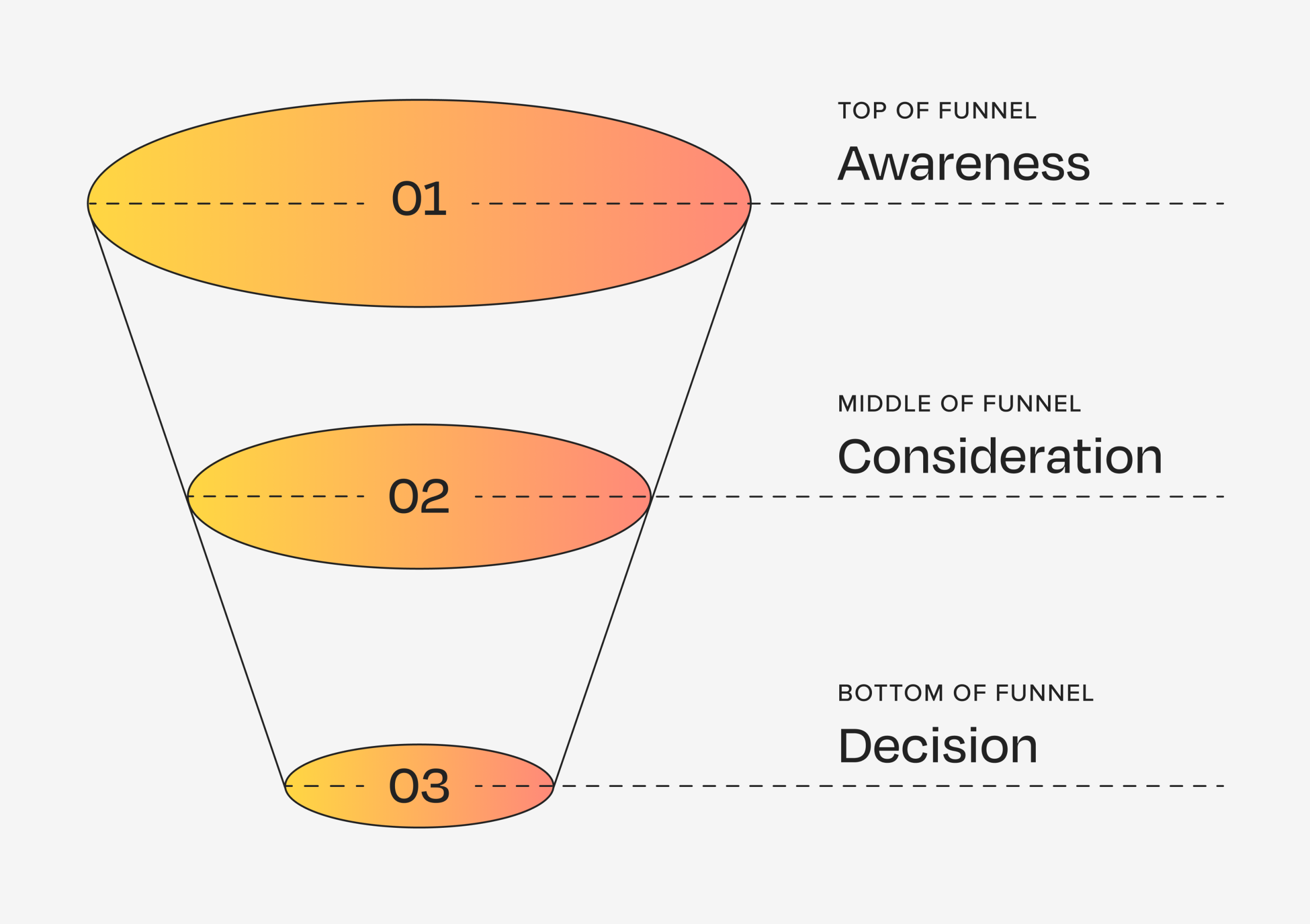
At the top of the funnel, content marketing plays the role of a teacher, with a focus on awareness and education. Blog content, guides, email newsletters, and thought leadership pieces help potential buyers name and understand the problems keeping them up at night while introducing your company as a knowledgeable resource—not just another vendor pitching solutions.
Mid-funnel content is where buyers get both serious and skeptical, so the emphasis is on consideration and evaluation. This is where competitor battle cards, build-versus-buy and buyer’s guides, product education resources, and webinars help prospects assess different solutions and build conviction around specific approaches. At this stage, your content needs to answer the hard questions: Why you instead of a competitor? Why buy instead of build? Why now instead of next quarter?
Bottom-funnel content is what closes deals, as it supports decision-making and conversion. At this stage, buyers are no longer asking, “Should we solve this problem?” or “How should we solve this problem?” They’re asking, “Can we justify this purchase to the CFO?” or, “Will our team actually use this platform?” Product demos, ROI calculators, customer success stories and case studies, and detailed technical documentation can give them the ammunition they need to secure internal buy-in and complete a purchase with confidence.
Measuring B2B content marketing ROI
Content marketing ROI can be difficult to measure. Content often influences buyers across multiple touchpoints through extended sales cycles, making closed deals hard to link to any one piece of content. A prospect might read three blog posts, download two guides, attend a webinar, and explore five case studies before converting—so which piece deserves the credit?
Key metrics for evaluating content marketing performance can include organic traffic growth, lead generation volume and quality, pipeline contribution, customer acquisition cost reduction, deal velocity improvements, and ultimately revenue attribution.
When measured properly, many B2B content programs can deliver 3:1 to 5:1 ROI or even higher, meaning every dollar invested in content returns three to five dollars or more in revenue. The catch is, you need to track ROI beyond vanity metrics like clicks and page views.
Sophisticated attribution models and clear KPI frameworks allow technology companies to demonstrate concrete returns.
The most forward-looking content marketing teams use multi-touch attribution models to understand how different content assets influence buyer behaviors and actions at various journey stages, allowing for continuous optimization toward revenue outcomes.
Multi-touch attribution may be tricky to track, but there are a number of marketing tools designed to help, including Factors.ai, HubSpot’s attribution reporting feature, Marketo Measure (formerly Bizible) by Adobe, Dreamdata, HockeyStack, and Ruler Analytics. For content-specific tracking, platforms like Semrush and HubSpot Marketing Hub can help teams connect organic search performance and content engagement metrics directly to pipeline and revenue, making it easier to prove a content strategy’s business impact.
However you go about it, understanding your B2B content marketing ROI helps justify continued investment and identify your highest-performing content types.
B2B content types
B2B content marketing spans many diverse formats, with each type of content serving a different purpose within your overall strategy.

Educational and thought leadership content includes blog posts, long-form guides, research reports, social media posts, original data studies, and even infographics. This content does the heavy lifting at the top of your funnel. It’s the content that ranks in search engines, gets shared on LinkedIn, and builds trust in your brand before prospects have even heard your pitch.
Product and solution content like comparison pages, product documentation, feature explainers, and technical specifications helps prospects evaluate your offerings against alternatives and understand implementation details.


Customer validation content such as case studies, testimonials, video success stories, and ROI calculators provides social proof and demonstrates real-world value, addressing the critical question of whether your solution actually delivers promised results.
Interactive and multimedia content including gated webinars, podcasts, video tutorials, interactive tools, and assessments engages buyers through different learning modalities while capturing high-value lead information.


Finally, sales enablement content like one-pagers, competitive battle cards, ROI templates, and proposal frameworks equips your sales teams to have more effective conversations with prospects.
It’s best not to try to be everywhere at once. Be where your buyers actually are. Experiment across content formats to find what resonates, then double down on what’s working. If your target audiences devour long-form guides but ignore your webinars, that’s valuable information. Research effective content marketing examples and strategies across different sectors to find inspiration for your specific approach.
Content marketing for B2B audiences
Keep in mind, not all types of content work equally well for every audience. The right mix depends heavily on who you’re trying to reach and what they need to make a decision. Consider these factors when planning your content strategy:
- Your ideal customer profile (ICP) matters.
Are you selling to enterprise companies with complex procurement processes, or nimble mid-market teams and small businesses that move quickly? Enterprise buyers typically need more extensive validation content (like detailed security documentation, compliance certifications, and executive-level case studies), while small and mid-market buyers respond better to product-led content like interactive demos and quick-start guides that let them evaluate solutions independently. - Buyer roles shape content preferences.
A CTO evaluating your DevOps platforms needs technical depth, including architecture diagrams, API documentation, and performance benchmarks. However, a business-minded VP might care more about business outcomes, integration capabilities, and team adoption specs. Create role-specific content paths that speak directly to each stakeholder’s priorities and concerns. - Company stage influences needs.
Early-stage startups often seek tactical, how-to content that helps them execute quickly with limited resources, while more mature companies look for strategic frameworks, industry research, and thought leadership that helps them think bigger. Tailor your content depth and sophistication to match where your buyers are in their own company journey. - Industry and vertical considerations can’t be ignored.
A healthcare SaaS company will likely need content that addresses HIPAA compliance and patient privacy. On the other hand, a financial technology (fintech) company is juggling regulatory compliance concerns and data security requirements and will necessitate its own, unique strategy. Your content should reflect not just what your product does, but how it solves the challenges and demands that are specific to your buyers’ industries.
Content marketing for technology and SaaS audiences
Similarly, technology and SaaS companies face unique content marketing challenges and opportunities.
For example, technical complexity represents both an obstacle and an advantage. While tech solutions often require significant education, this creates opportunities to demonstrate expertise through genuinely valuable educational content that competitors may struggle to match. In other words, your product’s complexity could actually be a content moat if you explain it well.
Product-led growth strategies common in SaaS can also be enhanced through content that supports self-service discovery and evaluation. Comprehensive documentation, tutorial content, and use case libraries help prospects understand value before speaking with your sales team.
Additionally, in tech, yesterday’s insights become today’s outdated advice alarmingly fast. Commit to regular content audits and updates, especially for product documentation and technical guides. Nothing tanks your credibility faster than a “2016’s Best Practices” guide still ranking for key terms in 2026.
Looking for content strategy guidance specific to B2B fintech? Check out our comprehensive guide.
How to build a B2B content marketing strategy
Successful B2B content marketing requires strategic planning, not just rapid content creation. The companies that win with content aren’t necessarily the ones publishing the most. They’re the ones publishing the right content, for the right audience, at the right time.
Here’s how to build that strategic foundation:
- Start with audience research. Developing detailed B2B buyer personas based on real customer data, interviews, and behavioral insights ensures your content addresses actual needs rather than just assumptions. Understanding audience pain points, goals, information needs, and content preferences provides the foundation for strategic content decisions.
- Conduct a content audit. Before creating new content, assess what you already have. A comprehensive B2B content audit can identify gaps, opportunities, outdated content, and high-performing assets worth expanding, updating, or removing. Downloadable content audit templates available widely online can streamline and simplify this process.
- Define clear objectives, benchmarks, and KPIs. Align your content marketing goals with your broader business objectives. Whether you’re focused on lead generation, pipeline acceleration, brand awareness, or customer retention, establish specific, measurable targets that demonstrate your content’s business impact.
- Map content to the buyer’s journey. Plan content that serves prospects at each stage of the funnel, from awareness to consideration to decision. This ensures you’re creating a complete content ecosystem that moves buyers steadily toward meaningful conversions rather than random pieces working toward an unclear end.
- Develop your content marketing strategy framework. A structured B2B content strategy template should help you document audience insights, competitive positioning, content themes and pillars, ideal content mix, publication cadence, distribution channels, measurement framework, and resource allocation, among other components. Having a working document like this in place will guide execution while keeping you flexible enough to adapt based on incoming performance data.
Distribution channels for B2B content marketing
Creating excellent content is only half of the equation. The other half is effective content distribution, which ensures your target audience actually sees and engages with your work. Great content that nobody reads is just expensive blogging.
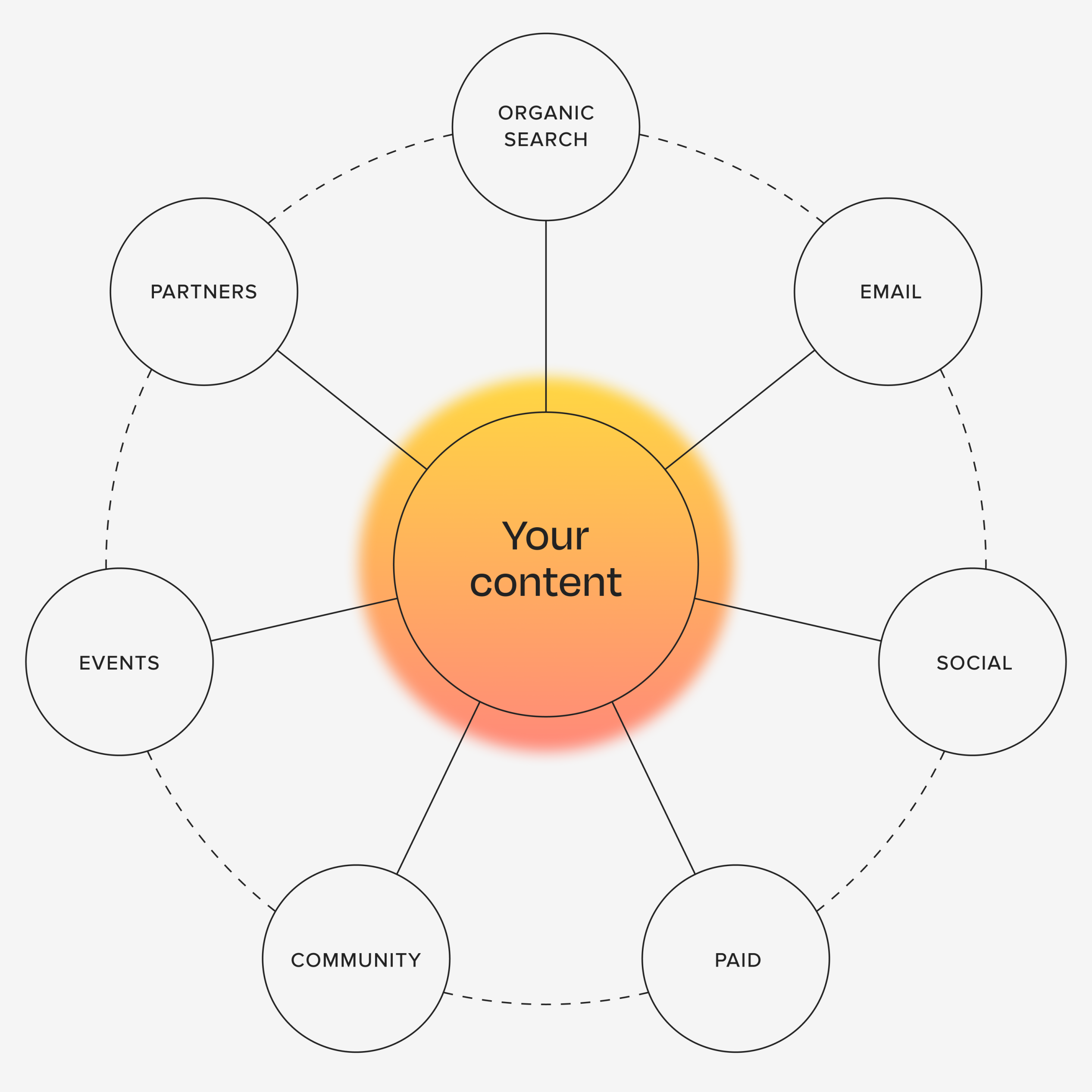
Here are just some of the essential distribution channels to consider in your content marketing strategy:
- Organic search is the gift that keeps on giving. Unlike paid ads that disappear the moment you stop paying, content that ranks organically on search engines like Google continues to drive qualified traffic month after month, year after year.
Approaching search engine optimization (SEO) as a B2B brand requires understanding how and what business buyers actually query, targeting appropriate keywords with reasonable competition levels, building topical authority through comprehensive content coverage, and earning backlinks from other authoritative industry sources. With Google and other search engines increasingly incorporating AI overviews and models in their search results, optimizing B2B content for AI search is also becoming essential for maintaining visibility.
- Email marketing provides direct access to specific, engaged audiences. B2B email marketing allows for segmented, personalized content delivery to prospects and customers at scale. Additionally, newsletter programs, nurture sequences, and targeted campaigns based on buyer behavior or firmographic data can help push contacts progressively through the sales funnel.
- Social media content has evolved significantly in B2B digital marketing. Of course, LinkedIn dominates as the primary social media platform for B2B content distribution, offering both organic reach through employee advocacy and targeted paid promotion. Twitter/X also serves thought leadership and real-time industry commentary for easy social sharing opportunities. Meanwhile, niche communities on platforms like Reddit and specialized Slack groups can provide highly targeted distribution for more technical content.
- Paid promotion can accelerate content outreach beyond organic channels. Targeted advertising on channels like LinkedIn, Google, and industry-specific platforms helps content reach specific job titles, companies, and intent signals. Sponsored content partnerships with industry publications can also extend reach to established audiences.
- Community and partnership distribution multiplies your content marketing efforts. Contributing guest posts to industry publications, participating in podcasts, speaking at events, engaging in influencer marketing, and co-marketing with complementary businesses can expose your content to new audiences while building both authority and backlinks.
The reality is, your buyers aren’t reading just one blog post and converting. They’re finding your social media accounts, clicking through to your blog, subscribing to your newsletters, downloading a few guides, reading case studies, and then maybe requesting a demo. Build for that multi-touch, cross-channel journey instead of spending all of your resources on a single tactic.
Content marketing best practices for B2B tech
Certain principles consistently separate effective B2B content marketing initiatives from mediocre efforts that fall flat. Here are our essentials:
- Prioritize quality over quantity. Publishing one thoroughly researched, genuinely useful piece of content monthly delivers better results than churning out numerous thin, generic posts. Business buyers are savvy and will quickly recognize and dismiss low-quality content. Better to publish nothing at all than to publish something that makes readers question your worth and expertise.
- Lead with value, not self-promotion. The most effective B2B content educates and informs audiences, offering expert knowledge and actionable advice instead of just pitching a product. Save promotional and salesy messaging for later-stage content while using earlier-funnel content to build trust through helpful guidance.
- Back up claims with hard evidence. Technical buyers are highly analytical and skeptical. Support your assertions with concrete data, cite credible sources, and provide specific examples rather than vague generalities. Original research and proprietary data in particular can help differentiate your content in crowded markets.
- Write for humans, but optimize for search. While SEO matters, content that reads like it was written for algorithms rather than people often fails to engage or convert. Balance keyword optimization with compelling writing and natural, readable language that addresses reader needs. If you wouldn’t enjoy reading it yourself, your audience won’t enjoy reading it, either.
- Make content scannable and actionable. Business buyers are busy. Use clear formatting and style, descriptive headings, concise paragraphs, and bulleted lists to help readers quickly extract the information they’ve looking for. You can also include tables of contents, focused takeaway sections, and clearly defined next steps instead of walls of text to quickly orient your readers.
- Maintain consistency. Regular publication cycles will build up audience expectations and compound SEO benefits over time. Whether you publish daily, weekly, or monthly, establish a realistic and sustainable cadence, and then stick to it.
If you want to go deeper, this tactical guide with content marketing best practices breaks down the details of what separates high-performing content from expensive fluff that collects digital dust.
Common mistakes in B2B content marketing strategies
Even sophisticated tech companies make predictable content marketing mistakes that undermine results. Avoid these common pitfalls:
- Creating content without strategy is perhaps the most common error. Random topic selection based on internal interests rather than true market needs wastes resources on content that doesn’t support audiences’ actual business goals. Every piece should serve a clear strategic purpose. Ask yourself: Would our ideal customer actually search for and read this? Does this move a buyer closer to conversion? If the answer to both is “no,” reconsider.
- Neglecting distribution results in valuable content that nobody sees or reads. Many companies invest heavily in content creation while treating distribution as an afterthought, resulting in low engagement and impact despite high-quality work.
- Focusing exclusively on your platform and features rather than buyer problems can alienate prospects who aren’t yet ready for in-depth, product-specific content. Most of your content should address key business challenges and high-level industry topics, not just your own offering.
- Ignoring the full funnel creates critical gaps in the buyer’s journey. Companies that only create top-funnel awareness content struggle to convert traffic into leads, while those focused solely on bottom-funnel content lack the audience-building steps that feed conversion opportunities.
- Failing to measure and optimize content means you can’t identify what’s working or improve outcomes over time. Without clear KPIs and regular performance analysis, content marketing becomes an act of faith rather than a data-driven growth function.
- Underinvesting in promotion of your highest-performing content also represents a missed opportunity. Rather than constantly rolling out new content, successful programs identify and amplify top performers through updated distribution efforts, paid promotional campaigns, and repurposing into additional formats.
Building your B2B content marketing team
Technology companies face an important decision about using a content marketing agency versus building an in-house team. The truth is, there are benefits to both sides—and, increasingly, the smartest approach combines elements of each.
- In-house marketing teams offer deep product and industry knowledge, tight integration with other business functions, and full control over content strategy and messaging. However, they also require significant investment in hiring the right people and cultivating specialized talent, and smaller teams may lack necessary breadth across content types and distribution channels.
- Content marketing agencies bring diverse experiences and expertise, established processes, and scalability to the table without the overhead of full-time employees. Selecting the right B2B content marketing agency requires evaluating for industry-specific knowledge, strategic capabilities beyond execution, cultural fit, and proven results with similar companies. For specialized fields like fintech, the best content marketing agencies must also be able to demonstrate that they understand the specific regulatory and audience considerations at play.
Many successful content programs take a hybrid approach, maintaining strategic direction and subject matter expertise in-house while partnering with agencies or freelancers for more specialized execution, scale, or specific types of content.
Emerging trends in B2B content marketing
The B2B content marketing landscape continues to evolve, creating both challenges and opportunities for modern technology companies. Today, some notable market trends and shifts include:
AEO and geo are reshaping how buyers discover B2b vendors
Answer engine optimization (AEO) and generative engine optimization (GEO) refer to the practice of optimizing content so that AI engines like ChatGPT, Perplexity, Claude, and Google’s AI Overviews surface your brand and cite your content in their responses. Unlike traditional SEO, which optimizes for ranked links, AEO and GEO optimize for inclusion in synthesized answers.
But there’s an important distinction most agencies aren’t yet drawing: citation rate (how often AI engines link to your content) and mention rate (how often AI engines name your brand) are different metrics, and they can diverge sharply:
- A B2B brand can have a high citation rate but a low mention rate if its content is well structured and authoritative, but disproportionately serving top-of-funnel informational queries. In these cases, AI engines may be happy to quote your content’s “what is X” definitions, but when a buyer asks “which vendor should I use for X,” your brand never comes up.
- The reverse is also possible: you could have a high mention rate but low citation rate. In this case, third-party sources like Reddit, listicles, and review sites are doing the work of building your brand while your owned content is invisible. This puts third-parties in control of your brand narrative and AI’s perception of your brand, and that might not always be in your favor.
The goal state is both—where AI engines name your brand in response to buyer-intent prompts and cite your content as the explanation behind the recommendation. Getting there requires content that does two jobs at once:
- Earning citations through direct, extractable answers in the first 1–2 sentences of each section, question-based headings, named sources, and original research
- Shaping AI’s perception of your brand through middle- and bottom-of-funnel content, comparison pages, customer stories, and category-defining thought leadership that signals you’re a vendor worth recommending.
Structurally, that means more FAQ sections, more comparison tables, more “what is X” definitional content paired with explicit “why us” content, and more original data. These are the formats AI engines reach for when assembling answers, plus the brand signals that get you into those answers in the first place. B2B brands that adapt early will own meaningful real estate in AI-mediated search before competitors catch up; those that don’t may find their organic traffic eroding even as their rankings hold.
Learn more about how AI is transforming the fintech buyer’s journey, the martech buyer’s journey, and the AI buyer’s journey.
AI and automation are transforming content creation and optimization
Their has been an exponential surge of large language models and AI-powered automation tools to assist with content research, drafting, optimization, and distribution. While AI tools can accelerate research, aid in outline generation, and quickly sketch out first drafts, the most effective content marketing still requires human judgment, strategic and critical thinking, and an authentic brand voice. The key is using AI to support and enhance rather than replace human-led strategy, creativity, and insight. Think of AI as your assistant, not your lead strategist or creative.
Buyer intent signals and personalization allow for more sophisticated content experiences
Personalization in B2B content means delivering the right content to the right person based on who they are, what they do, and where they are in the buying process. Technology now enables serving different content to different audiences based on firmographic data (like company size, industry, and revenue), behavioral signals (like pages visited or assets downloaded), and inferred intent—making content more relevant and valuable to individual prospects rather than speaking generically to everyone at once.
Video content and multimedia formats continue to gain importance
Video and multimedia content encompasses any non-text format—short-form video, long-form explainers, podcasts, webinars, interactive tools, and more—designed to engage audiences through modalities beyond reading. These formats aren’t just supplementary anymore. Short-form video in particular has gained significant traction as a way to capture attention quickly and communicate complex ideas in accessible, shareable ways. Used strategically alongside traditional long-form written content, multimedia formats can extend your reach and meet buyers wherever they prefer to consume information.
Content as the foundation for community-led growth
Community-led growth is a strategy that shifts content from one-way publication to ongoing, participatory conversation—one where your brand becomes a hub rather than a broadcaster. Rather than simply publishing and hoping audiences find you, this model emphasizes collaborative discussions, user-generated content (UGC), and peer-to-peer networks built around shared professional interests. For B2B tech companies, this might look like a Slack community for customers, an invite-only forum for practitioners, or a LinkedIn-native content strategy designed to spark dialogue rather than just drive clicks.
Staying current with emerging content marketing trends can help technology and SaaS companies maintain a competitive advantage in an increasingly complex and sophisticated landscape.
Getting started with B2B content marketing
For tech companies ready to invest seriously in content marketing, the path forward involves several essential steps.
- Begin with strategy. Invest in audience research, competitive analysis, and strategic planning before executing random content. Document your approach in a content marketing strategy framework that enables consistent decision-making.
- Audit existing content to understand your starting point. Identify what’s working, what’s not, where gaps exist, and which content needs updating or removal.
- Start with owned distribution channels. Look to assets like your website, blog, and email list before expanding into other areas. Build a foundation on platforms that you already control before depending on third-party channels.
- Commit to consistency over perfection. Publishing good content regularly delivers better long-term results than waiting to launch “perfect” pieces. Your first few pieces won’t be your best, and that’s perfectly fine. You learn by doing.
- Measure what matters. Establish clear KPIs aligned with your specific business goals, implement proper tracking, and regularly review content performance to inform optimization.
Finally, consider bringing in expertise through a content marketing agency partnership, fractional leadership, or key strategic hires if content marketing capabilities don’t currently exist in-house.
Frequently asked questions
What is B2B content marketing?
B2B content marketing is the strategic creation and distribution of valuable content designed to attract, engage, and convert business buyers. It supports the buying processes typical of business-to-business (B2B) purchases by educating prospects, building trust, and demonstrating expertise across long sales cycles and multiple stakeholders.
How is B2B content marketing different from B2C?
B2B content marketing targets business decision-makers navigating complex procurement processes, while B2C (business-to-consumer) content marketing targets individual consumers making faster, sometimes more impulsive purchases. B2B content tends to be more research-heavy, technically detailed, and ROI-focused, and it must satisfy multiple stakeholders—from technical evaluators to financial approvers—across sales cycles that can span months or years.
How much do B2B companies spend on content marketing?
Research by Hubspot shows the average B2B company invests 8–11% of revenue in marketing, and much of that goes to channels that are content‑driven. According to the report, the top channels by both adoption and ROI include website/blog/SEO, organic social media content, email marketing, paid social media content, brand awareness campaigns, “content marketing” as a named channel, and video marketing. Functionally, 8–9 of the top 10 channels depend on consistently producing and distributing high‑quality content, even though only one line item is explicitly labeled “content marketing.” This suggests that much of the modern B2B marketing budget is a content budget.
What are the most effective B2B content marketing formats?
The most effective B2B content formats are the ones that match where your buyer is in the journey and help them reduce perceived risk: educating early, comparing options in the middle, and justifying a decision at the end.
- Educational blog posts and how‑to guides. These drive discovery and early‑stage trust via organic search. For example, many SaaS and fintech brands publish “ultimate guides” that rank for problem‑led keywords and then nurture visitors into demos or trials.
- Webinars and live demos. Webinars regularly show up among the highest‑performing formats for lead generation and qualification because they let prospects see your thinking and your product together.
- Case studies and customer stories. Buyers consistently rank case studies and success stories as some of the most influential content when they’re close to a decision, because they show real outcomes and context. A common pattern is what you see in many B2B digital programs: blog content + whitepapers + webinars + case studies working together to deliver hundreds or thousands of inbound leads at a positive ROI.
- Research reports, whitepapers, and original data. Data‑rich reports and whitepapers are especially effective in enterprise because they signal expertise. They are also more likely than other content types to generate backlinks and press.
- High‑intent landing pages and product explainersWhen prospects are in‑market, clear product pages and comparison content do the heavy lifting. Strong B2B programs use landing pages tied to specific use cases or verticals, then support them with content like analyst reports, ROI explainers, and implementation stories.
How long does B2B content marketing take to show results?
Most B2B content marketing programs begin showing meaningful results in six to twelve months, with compounding returns building over 18 to 24 months. Early wins like lead generation from gated assets and brand mentions from AEO efforts can happen within a quarter, but organic search authority, brand recognition, and pipeline contribution typically require sustained publication and distribution before they translate to measurable revenue impact.
What should a B2B content marketing strategy include?
A B2B content marketing strategy should include audience research and buyer personas, clear business objectives and KPIs, a content audit, content themes mapped to the buyer’s journey, a distribution plan, and a measurement framework. The strongest strategies also document competitive positioning, publication cadence, and resource allocation so teams can execute consistently and adapt based on performance data.
How do you measure B2B content marketing ROI?
B2B content marketing ROI is measured by tracking the revenue and pipeline generated by content against the total cost to produce and distribute it, typically using multi-touch attribution to credit content’s influence across long sales cycles. Beyond revenue attribution, useful metrics include increased mention and citation rates, greater share of voice, organic traffic growth, lead quality, deal velocity, and customer acquisition cost reduction.
Key takeaways
B2B content marketing represents one of the most effective and sustainable growth strategies available to technology and SaaS companies today.
By creating genuinely valuable content that educates buyers, demonstrates expertise, and builds trust throughout extended sales cycles, you can generate qualified leads, accelerate pipeline, and drive revenue growth.
Content marketing success requires strategic thinking, consistent execution, effective distribution, and ongoing optimization based on performance data. Whether you build capabilities in-house, partner with a specialized agency, or take a hybrid approach, the companies that win with content marketing are those that commit to understanding their audiences deeply and serving their needs authentically.
The businesses that view content marketing as a core growth function rather than a perfunctory marketing activity will build sustainable competitive advantages that compound over time—capturing organic search traffic, earning mind share with target buyers, and establishing thought leadership that translates directly to revenue.
Continue the conversation
Have questions about building an effective content marketing program for B2B tech? We’ve got answers!
Reach out to the Block Club team to learn what a successful content marketing strategy could look like for your team—or check out our work with businesses like yours to see high-performing strategies in action.
About the author
Julia Bozer is Associate Director of Strategy at Block Club, where she specializes in brand messaging, go-to-market positioning, and content strategy for B2B tech and fintech companies. A Harvard graduate with a Ph.D. and background as a translation specialist and MoMA fellow, Julia brings a rare combination of academic rigor and commercial acumen to her work. She has developed brand and content strategy for clients that include Codat, Lithic, Rho, Stytch, and Pigment. She writes on B2B brand positioning, fintech messaging, and the craft of translating complex technical concepts for business audiences.