
Tell, Show, Prove: How Airship Rebuilt Their AI Product Messaging Around Outcomes


If you market a B2B tech product, you’ve likely added AI product messaging to your strategy over the last year, along with each of your competitors. Buyers now read “AI-powered” or “AI-driven” the way they usually read “best-in-class”—as something every vendor promises, but few can defend.
Airship, the mobile-first, cross-channel customer experience platform, faced this exact problem.
It was the first to put pre-trained AI agents and real-time decisioning into production, putting it far ahead of the curve on a technical level. However, when we tested Airship’s AI messaging, enterprise buyers told us they found it relevant to their work but indistinguishable from what every other CX platform was saying about AI.
In the summer of 2026, we worked with Airship’s marketing, product, and leadership teams to rebuild their AI product messaging strategy from the ground up. The project started with buyer research and ended with a simple formula, built into Airship’s messaging toolkit, that tests every claim before it goes live. Each claim now needs to do at least two of three things: tell it in clear, specific language; show it with a demo or product visual; and prove it with a verifiable stat or credential.
Below, we walk through how we got there—including what we heard from buyers, how we positioned Airship’s AI to meet their standards, how we built the formula, and how we put it to work on Airship’s website. The same approach can work for any enterprise B2B tech brand whose AI messaging needs to stand out from the crowd.
This AI work built on a full brand transformation we had already launched for Airship. See how we repositioned the Airship brand in our Airship case study →
What buyers told us about AI messaging
Most AI messaging is written from the inside out, starting with what the product does and what leadership wants to say about it. For Airship, we started from the outside in, prioritizing what buyers need and want from AI messaging. Specifically, we pulled together three critical sources of evidence:
- A survey of enterprise customer experience decision-makers that we ran through Wynter
- Responses from key members of Airship’s customer advisory board
- A competitive analysis, auditing how eight close competitors talk about AI
These three sources converged in telling areas, with several findings running against the way most AI messaging gets written:
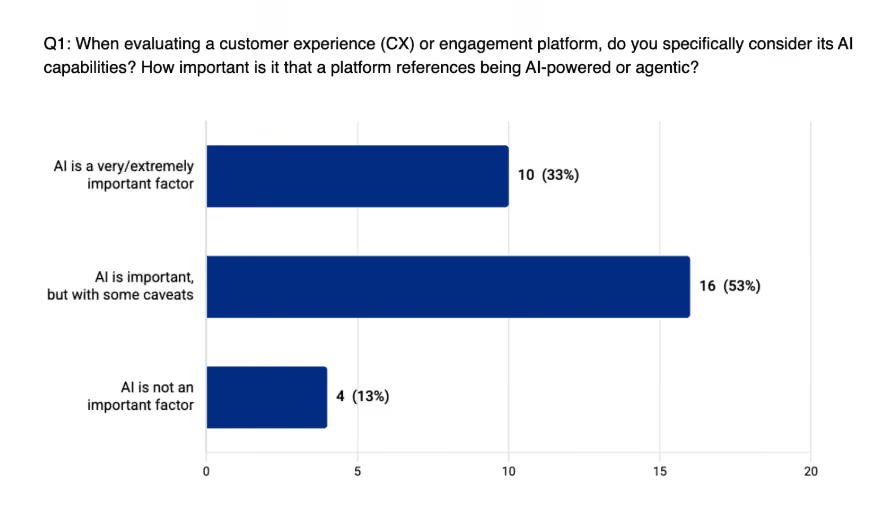
- The AI label alone carries little weight. Nearly nine in 10 buyers (87%) factor AI into their vendor evaluations, but around two-thirds will dismiss AI messaging if it’s missing concrete qualifiers like hard proof or product specifics.
- Buyers are looking for a co-pilot. Seventy-three percent of buyers we surveyed want heavy human oversight or shared control over AI. None want fully autonomous agents.
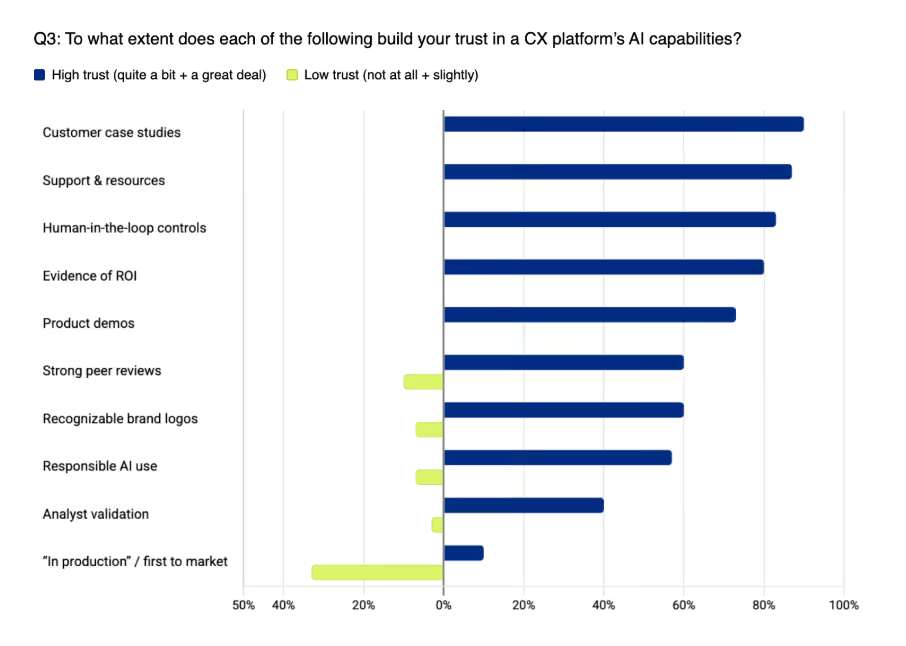
- Credibility outranks credentials. Buyers turn to case studies (90%), access to implementation support (87%), human-in-the-loop controls (83%), and evidence of ROI (80%) to build trust in an AI offering. Validation from third-party analysts ranks much lower, at 40%.
- “First to market” messaging can backfire. First-mover claims, which Airship had previously relied on, ranked last of the 10 trust signals we tested, and they were the only signal that more buyers distrusted than trusted.
What we did for Airship: As part of the Wynter survey, we showed buyers the AI section of Airship’s homepage. They rated it highly on relevance and importance, but net-negative on how compelling, credible, and differentiated it was overall. Their open-ended answers explained why: The copy leaned on the same words the rest of the category was using, including being “first.” Meanwhile, it buried the parts buyers cared about most, like human-in-the-loop controls and verified business outcomes. One respondent wrote that they didn’t care about Airship being first to production, but they did like the human safeguards in place around Airship’s AI features.
Together, these findings formed the basis of our AI messaging strategy: Lead with the proof, keep people in control, and drop the empty claims buyers have learned to discount.
"AI capabilities are an important consideration, especially for automation, personalization, and analytics. However, being labeled 'AI-powered' or 'agentic' is less important than the platform’s ability to deliver tangible business value, reliability, and ease of use." – Survey Respondent, Senior Product Manager in Financial Services
Putting outcomes first and AI in a supporting role
The buyers in our research wanted more time back, better predictions, and verified results they could bring to their leadership teams. AI mattered to them as a way to get there, not as the headline itself. So we tied Airship’s AI messaging to the brand promise Airship already makes (“Results guaranteed”) and positioned AI as what makes those results better and faster.
Our guidance for the Airship team was simple: lead with the outcome, and bring in AI to explain how customers get there.
Additionally, while Airship has a long record of firsts—having launched the first push notification and the first mobile wallet pass, as well as the industry’s first live AI agents—we listened to buyers and deprioritized that legacy in top-line AI messaging, replacing it with verifiable proof points. We also gave Airship’s team a short list of preferred terms, like “outcome-led AI,” and a list of phrases to retire, including “AI-powered” and “autonomous.”
How the “tell, show, prove” formula works
A positioning and messaging strategy tells a team what to say, but it won’t stop the next digital ad or sales deck from drifting back into hype. For that, Airship needed a test simple enough to apply to any asset in just a few seconds. The formula we built for them has three parts:
- Tell it with clear, specific language even a nonspecialist can understand
- Show it with a product demo, walkthrough, screen capture, or animation
- Prove it with a verifiable statistic, credential, or customer testimonial
Every claim—especially about AI—needs to hit at least two of these three before going out. Two is the target, and three is the ceiling. A claim with only one element reads as an empty promise, which buyers now discount by default. But stacking more evidence on top of all three starts to oversell and can read as defensive, which invites back the distrust the formula is meant to remove.

The formula also works as an editing tool. Consider applying it to a typical AI claim:
- Before, it might read: “Our revolutionary AI agents transform the way teams work.” This tells the reader very little, gives them no visibility into how the agents might function in their operations, and offers no proof to build their trust.
- After, it could be rewritten as: “Give our Campaigns AI Agent a brief, and it returns a draft cross-channel campaign. Your team edits and approves everything before it goes live,” accompanied by a screenshot of the agent in action. This says exactly what happens, defines who’s in control, and visualizes how the product achieves its goals. Add a verified time-to-launch figure from a named customer, and the claim is ready to ship.
Putting the formula to work where buyers look first
Of course, a formula only moves the needle if it shows up in the assets buyers see. For most B2B companies, the website tends to come first.
What we did for Airship: Airship’s refreshed homepage follows the order buyers asked for. It opens with the outcomes (“Accelerate loyalty, revenue, and growth. Results guaranteed”), then moves straight into a proof section (“Proof over promises”), with customer stories and findings from a Forrester Total Economic Impact study. AI messaging comes after that, in a section built on the “tell, show, prove” formula:
- Tell: The headline (“Give it a goal, put it to work, approve it at every step”) says what Airship’s AI does and who stays in charge.
- Show: Each AI agent gets its own card, with a plain-language description and a real visual of the product at work.
- Prove: A link to Airship’s trust center lets legal and compliance teams review Airship’s AI governance program for themselves.
We also packaged our output into an AI positioning and messaging toolkit for Airship’s marketing, sales, and product teams to refer to in their day-to-day work—complete with a headline library, talking points, and voice and tone rules. The “tell, show, prove” formula sits at the front of it, so everyone talking and writing about Airship’s AI can apply the same test to each claim.
How to apply our approach to your own AI messaging
A few simple guidelines can help you bolster your AI marketing strategy:
- Check in with your audience: Before you write a single word, conduct a short survey of your target buyers. This will help you understand which claims build trust and which they’ve learned to ignore or discount.
- Lead with outcomes: Unless AI is your core offering, put it in a supporting role. Your job is to explain how it helps customers get better results, not to AI-wash every claim.
- Run every claim through a credibility test: You can use our “tell, show, prove” formula to ensure each one has at least two of the three things buyers are looking for before it ships.
- Name the human in the loop: End each claim about AI with the steps your customer’s team will still own, like reviewing, editing, or approving the output.
- Start building proof right away: Named case studies and verified customer data take the longest to produce, but they’re still the signals buyers trust most.
Today’s martech buyers care deeply about AI, but they want hard evidence before they’ll take a vendor’s claims at face value. A simple formula like “tell, show, prove” gives every team, from product and marketing to sales, the same standard for what an AI claim needs before it’s brought to market.
If your AI story has started to sound like everyone else’s, start where we did with Airship: ask buyers what they believe, then build your findings into every claim.
Looking for more B2B tech marketing inspiration? Check out 10 content strategy examples to fine-tune your approach →
About the Author


Julia Bozer is Associate Director of Strategy at Block Club, where she turns complex B2B tech concepts and turns them into ownable brand positions. A Harvard graduate with a Ph.D from NYU, and former translation specialist and MoMA fellow, Julia has a rare gift for finding the clear, human idea inside dense technical products, and the commercial instinct to make it sell.
She's built brand messaging, go-to-market positioning, and content strategy for B2B tech companies where the product is genuinely hard to explain (Codat, Pigment., Airship) The harder the category, the better the work tends to be, because the whole challenge is the one she's built for: turning what a company does into something a buyer immediately gets, and wants.
Her take on the moment: AI can generate endless copy about a complex product, but it can't decide what actually matters to a buyer—that's judgment, and it's getting more valuable, not less. She writes on B2B positioning, fintech messaging, and the craft of translating technical complexity for the people who buy.